Fixing Beef’s Carbon Footprint: The Science Behind Rotational Grazing and Grassfeeding
Fixing Beef’s Footprint:
Rotational Grazing and Grassfeeding to Reduce Greenhouse Gas Emissions
Marlena Entner, Bryn Faubion, Kenta Huanca, Yanet Magana-Vaquero, Vanessa Perez,
Kathleen Kaiser Peterson, Katherine Sun, Bryan Thai, Monica Victoria Thomas, Cait Whittard
School of Public Health, University of Washington - Seattle
NUTR 402 Autumn 2025: Food Systems Modeling and Analysis
Dr. Sarah Collier
December 4, 2025
Introduction
Beef production is a major source of agricultural greenhouse gas (GHG) emissions, driven largely by enteric methane and nitrous oxide from soils and manure (Cusack et al., 2021). Life-cycle comparisons show wide variation in beef’s GHG intensity across systems, which means management changes can achieve significant reductions (Cusack et al., 2021). This report focuses on production-side practices and proposes a practical pathway: managed rotational grazing paired with grassfeeding, which is raising and finishing cattle on forage rather than grain. In empirical syntheses, land-based carbon-sequestration strategies on grazed lands, including intensive rotational grazing, reduced net beef GHG emissions by about 46% on average, with rotational grazing alone reducing emissions per unit of beef by roughly 37%. Therefore, management changes can bring about meaningful reductions in GHG intensity, though net-zero outcomes are uncommon and soil-carbon gains may not always persist (Cusack et al., 2021).
Our analysis describes current U.S. beef production systems and evaluates a production-side transition to rotational grazing and grassfeeding. We explain how these practices can improve forage quality, soil health and drought resilience, thereby lowering GHG emissions per kilogram of beef while acknowledging limits and trade-offs. We then outline an implementation plan that includes cost-share for fencing and water infrastructure, targeted technical assistance, and monitoring of soil carbon, fertilizer use, and emission intensity and conclude with expected impacts and feasibility. We also include a causal loop diagram to show how the proposed practices influence the key outcomes across the systems. The goal of this report is to provide a clear, evidence-based recommendation to reduce the GHG footprint of beef production through specific, field-level management changes (Cusack et al., 2021).
Background
In the United States, the beef production system can be divided into three main stages: cow–calf, backgrounding/stocker, and finishing. Cow-calf operations manage breeding and calving with about a 285-day gestation period and weaning at roughly 6-9 months of age with the weight of around 500-700 lb, primarily on pasture. Weaned calves then enter backgrounding or stocker programs to add frame and weight—mostly on forage with targeted supplements. Finally, cattle are finished either in feedyards on high-energy grain rations or on high-quality forage until they reach market weight, commonly about 1,200-1,300 lb, after which they move to federally inspected packing plants (Farm Credit of the Virginias, 2021). In this report, we use “grassfeeding” to mean raising and finishing cattle on forage (fresh pasture and stored forages such as hay or silage) with no grain finishing.
The U.S. is a major global producer: 2024 output was 27,051 million lb, while total U.S. consumption was 28,713.9 million lb, yielding a net balance of -1,662.9 million lb (USDA ERS). Feedlot finishing capacity is highly concentrated in the Central and Southern Plains, and roughly two-thirds of U.S. beef is produced in Nebraska, Kansas and Texas (Drouillard, 2018). Over the last four decades, U.S. beef production has increased even as domestic consumption remained comparatively steady, reflecting growing foreign demand for U.S. beef (USDA ERS; Drouillard, 2018). Trade is in two ways, where the U.S. exports largely to Japan, South Korea, China, Mexico, and Canada, and imports mainly from Australia, Canada, Brazil, Mexico, and New Zealand. In 2020, the U.S. imported a total of 1,072,252 metric tons and exported 941,502 metric tons. By value, the imports were $6.338 billion and exports $6.544 billion (Spradlin, 2022).
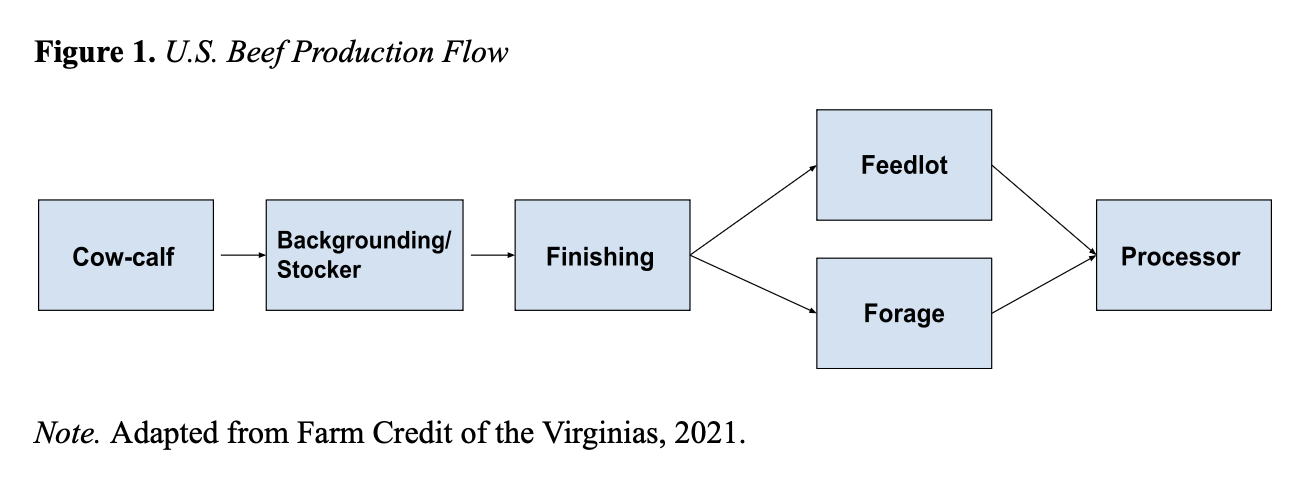
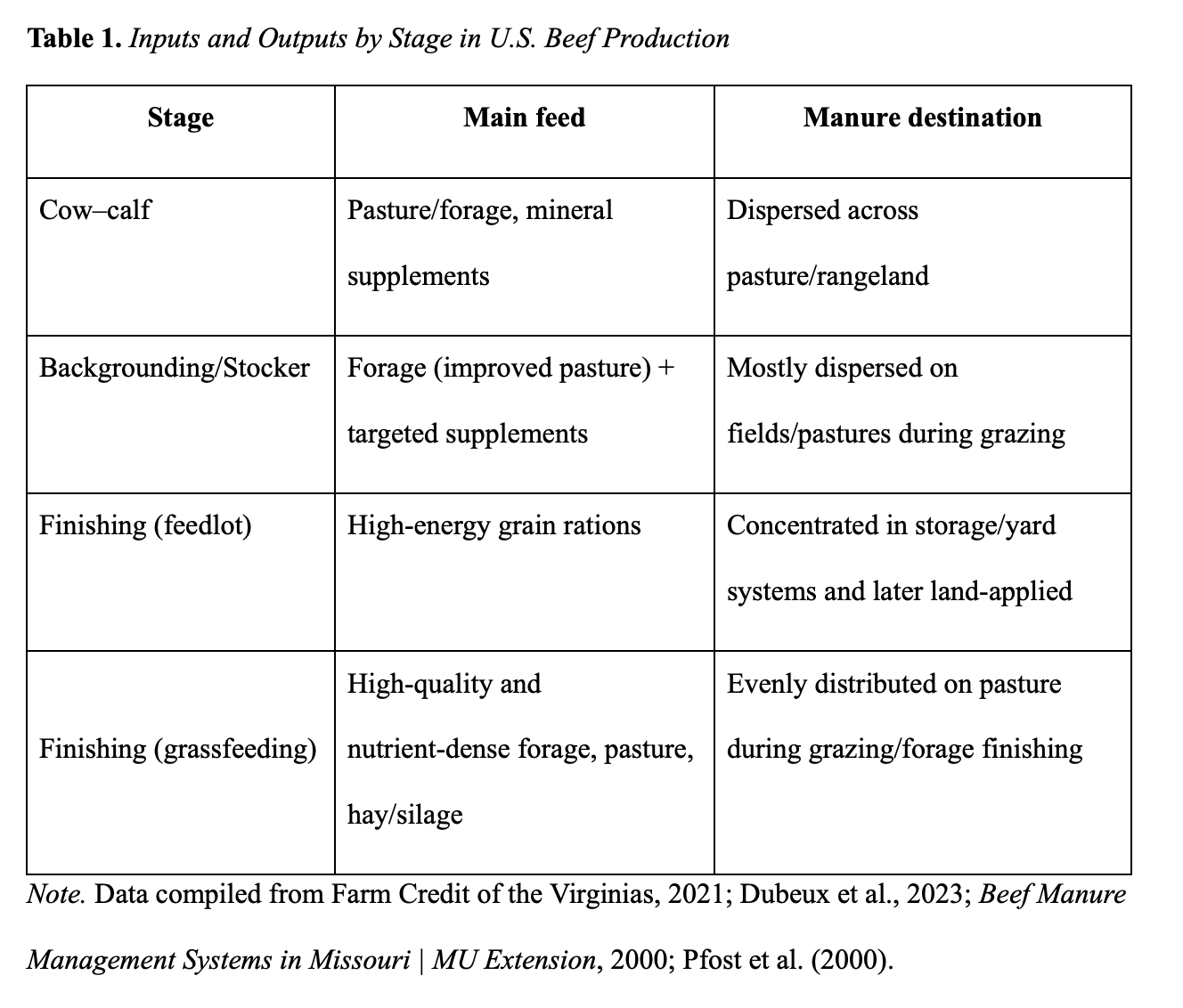
Figure 1 shows the flow of beef cattle production, and Table 1 lists major inputs and outputs by stage. Manure is distributed throughout fields and rangeland during the cow-calf and stocker phases, while pasture/forage serves as the main input. There are two different feeding methods at finishing: grassfeeding systems, where the primary input is high-quality pasture or stored forage and the manure is distributed evenly across fields, and grain-based feedlots, where the manure is concentrated in storage or yard systems and then land-applied. These variations in animal feeding and manure accumulation patterns influence fertilizer requirements, the nitrogen cycle, and GHG emission pathways (Beef Manure Management Systems in Missouri | MU Extension, 2000; Jason Smith, 2023).
The beef supply chain represents a highly coordinated system that ensures a consistent and reliable supply of beef to meet the demand of the United States’ population. The United States meat industry is controlled by four major companies: Cargill, JBS, National Beef Supply Co., and Tyson Foods (Montana Ranch and Cattle Company, 2024). Together, the four companies account for 80% of the beef processing industry (Montana Ranch and Cattle Company, 2024). This creates high efficiencies within slaughter and production sectors, yet limits opportunities for producers who look into alternative systems. These alternative systems are tied to grass-fed systems, which operate outside of the conventional model, as controlled and established by Cargill, JBS, Nation Beef Supply Co., and Tyson Foods (Mathews & Johnson, 2013). Transportation and distribution have established routes through refrigerated trucks, suppliers, restaurants, city institutions, public food procurements, and exports (Casagrande et al., 2024). This sector is a moderate source of emissions in comparison to cattle production; however, long-distance transportation, such as exports, adds to the beef’s carbon footprint.
Beef sustainability continues to be a complex issue that connects environmental, economic, and social challenges across the food system. The strengths of our current system involve feed efficiency in feedlots, existing infrastructure, and large rangeland availability. The United States meat industry has well-developed feedlots, transportation, and processing systems. High coordination among these systems allows for year-round beef supply due to high demand in the past century (Peel and Anderson, 2022). However, challenges arise within beef cattle production. These include Greenhouse Gas emissions (GHGs), land use, water use, energy use, and socioeconomic factors (EIP-AGRI Focus Group Sustainable Beef Production System, 2021). These factors shape the way sustainability is measured, often through the use of Life Cycle Assessments (LCAs), and gaps provide context for improvements (Cusack et al., 2021). Beef production emits a significant amount of GHGs, particularly methane, from cattle digestion and nitrous oxide due to fertilized feed crops (Figueiredo de Oliveira et al., 2025). Large land areas need to be used in order to graze and grow feed crops, which lead to deforestation and potential habitat loss. Sustainable improvements such as improved feed efficiency leads to reduced methane emissions and lower feed use; however, specialized feed can be costly and may increase the use for water or fertilizer. Socioeconomic factors such as labor conditions, farmers’ economic likelihood, and communal impacts are considered in sustainability assessments.
Across different sectors of beef production, feed input influences sustainability, often raising concerns and challenges. The sector of cow-calf relies heavily on grazing. Forage relies heavily on climate and quality (NOAA, 2025). Bad quality forage increases the time cattle spend breaking down, increasing contributions to methane (Figueiredo de Oliveira et al., 2025). Overgrazing reduces soil health, while reducing carbon storage and releasing it into the atmosphere (Menendez & Ehlert, 2025 & NOAA, 2025). These challenges highlight the need for discussion on reducing beef’s environmental footprint.
Solution
Part 1:
One impactful way to lower beef’s environmental footprint is to shift more U.S. cattle toward managed rotational grazing and grassfeeding. The idea is pretty simple: instead of leaving cattle on one big pasture until it’s worn down, you move them through smaller sections so the grass can rest and regrow. This helps the pasture stay healthy, spreads manure more evenly, and leads to stronger, more resilient forage. Grassfeeding means raising and finishing cattle entirely on forage instead of grain. When these two strategies are combined, the system ends up closer to natural grazing patterns and much more focused on soil health.
Healthy pastures actually do a lot for the environment. Research on adaptive multi-paddock grazing shows that giving plants recovery time leads to deeper root systems, higher biodiversity, and soils that hold more water and nutrients (Teague & Kreuter, 2020). It also helps pastures bounce back during droughts and reduces erosion. All of this strengthens soil health, which is one of the biggest long-term sustainability factors in beef production.
There is also a climate benefit. Well-managed pastures can store more carbon, and cattle usually produce fewer emissions per pound of beef because they’re eating higher-quality forage. A large global review found that rotational grazing and other land-based strategies can reduce the carbon footprint of beef by about 30-50%, which is significant for this industry (Cusack et al., 2021). It’s not perfect everywhere, but the overall trend is clear: better grazing management lowers emissions. These systems also tend to support more plant and insect diversity, which helps the whole ecosystem function better. Plus, when manure is naturally spread across fields, producers need less synthetic fertilizer, which further reduces emissions.
In short, rotational grazing and grassfeeding make beef production more sustainable because they rebuild the land instead of wearing it out. They’re practical, they fit into how many ranchers already manage their cattle, and the environmental and climate benefits are well supported by current research (Teague & Kreuter, 2020; Cusack et al., 2021). The next step is figuring out how these practices could realistically be implemented at scale and what challenges or trade-offs might come with that, which is what the following section covers.
Part 2:
Shifting U.S. beef production toward rotational grazing and grassfeeding is a practical way to reduce GHG emissions while improving ecosystem health. Scientific studies show that land-based strategies like rotational grazing can lower beef’s carbon footprint by 30-50% compared to conventional systems (Cusack et al., 2021). While the benefits are clear, putting this into practice requires careful planning, incentives, and support from producers.
One of the first steps for implementing rotational grazing is providing financial support to offset upfront costs. Farmers often need fencing to divide pastures, water systems for different paddocks, and tools to manage forage efficiently. These expenses can make switching to rotational grazing intimidating, even if it offers long-term benefits like better pasture quality and resilience to drought. Government programs, like the USDA’s Natural Resources Conservation Service (NRCS) cost-share programs, could be expanded to specifically support rotational grazing and grassfed finishing systems. Since these strategies also help capture carbon and reduce GHG emissions, public investment can be justified as a climate action (Cusack et al., 2021). Tax incentives could also encourage adoption. For example, producers could earn credits for lowering fertilizer use, increasing soil carbon, or demonstrating improved ecosystem outcomes. Because soil carbon gains vary and are not always permanent, credits should be tied to measurable, ongoing improvements rather than one-time actions (Cusack et al., 2021).
Another way to encourage adoption is to rethink subsidies and market support. Right now, federal subsidies for feed crops such as corn and soy indirectly favor grain-based feedlots by keeping feed cheap. Adjusting subsidies to support forage systems or gradually reducing subsidies that favor grain could help make grassfed systems more competitive. Policies could also create procurement standards that reward beef with verified lower GHG intensity. For example, schools, hospitals, and government agencies could prioritize sourcing beef from systems that use rotational grazing and grassfeeding. There are also simple policy tools, like farmer grants or a small beef tax, that could make this shift easier by helping ranchers cover costs and nudging consumer demand toward lower-emission beef.
Financial incentives alone are not enough. Many ranchers want to adopt rotational grazing but need practical guidance. Extension services could provide training on designing paddocks, tracking forage availability, and adjusting herd size during droughts. Since the success of rotational grazing depends on local climate, soils, and management skills, personalized support is essential. Monitoring is also key. Soil carbon gains, for example, are uncertain and may not last indefinitely (Cusack et al., 2021). Policies relying on carbon sequestration as a climate benefit need standardized monitoring frameworks. This could include soil sampling and remote sensing to track soil carbon, pasture productivity, and overall emissions intensity. Verified monitoring ensures that producers get credit for improvements while giving policymakers reliable data to support programs.
Despite clear benefits, there are real challenges. Grassfed systems require more land per animal than grain-fed operations, which can limit adoption in regions with less available pasture. Regional differences also affect outcomes; rotational grazing works well in some climates but less so in arid areas (Cusack et al., 2021). Market infrastructure is another challenge. Grain-finished beef fits the current U.S. processing system, which is optimized for high-throughput feedlot cattle. Grassfed cattle take longer to reach slaughter weight and often vary in size, which can strain processing schedules. Expanding regional, smaller-scale processing facilities is necessary but also expensive. Cultural and knowledge barriers also exist. Ranchers accustomed to conventional systems may hesitate to adopt new practices, especially when the payoff takes several years to appear. Demonstration farms, peer networks, and long-term profitability studies can help build trust and show that rotational grazing and grassfeeding can be both profitable and climate-smart.
Shifting to rotational grazing and grassfeeding affects more than just beef. On the crop side, reduced demand for grains could free up millions of acres for forage, cover crops, or perennial systems, improving soil health and reducing fertilizer runoff. However, this shift could hurt grain farmers unless alternative markets are developed for crops like corn and soy (Cusack et al., 2021). On the processing and retail side, grassfed beef often sells at a premium. If supply grows, the price gap might shrink, but it will likely remain higher than grain-fed beef. Institutions like schools or hospitals may need subsidies to afford grassfed beef. Consumer education also plays a role. If shoppers do not understand or value the lower-carbon product, demand may not support widespread adoption.
The environmental benefits extend beyond climate. Rotational grazing improves biodiversity, water retention, and soil structure. Healthier soils can buffer against drought, improve pollinator habitat, and support broader ecosystem resilience (Cusack et al., 2021). These benefits make rotational grazing an appealing option for integrated, climate-smart agriculture. Despite all of its advantages, rotational grazing and grassfeeding come with trade-offs. Grassfed cattle typically take longer to reach market weight, which can result in higher lifetime methane emissions per animal compared to feedlot systems. Management improvements, like optimizing forage quality, can help, but the difference does not disappear entirely (Cusack et al., 2021). Soil carbon gains are another area of uncertainty. While many studies show increases under managed grazing, the gains vary widely based on location, soil type, and rainfall. Some gains may decline over time, so policies must be careful not to over-rely on carbon offsets alone (Cusack et al., 2021).
Transitioning U.S. beef production toward rotational grazing and grassfeeding is realistic and backed by science. Managed grazing can reduce beef’s GHG intensity by 30–46% while improving soil health, biodiversity, and drought resilience (Cusack et al., 2021). However, success depends on carefully designed policies, financial incentives, technical support, and reliable monitoring. There are trade-offs, including slower growth rates, soil carbon uncertainty, and land-use pressure, but these challenges can be managed. Overall, rotational grazing and grassfeeding represent a practical, field-level solution for lowering the environmental footprint of beef while creating benefits for farmers, ecosystems, and consumers.
To show how these pieces interact across the beef system, we included a causal diagram that maps out the main relationships between rotational grazing, policy tools, emissions, land use, and market outcomes.
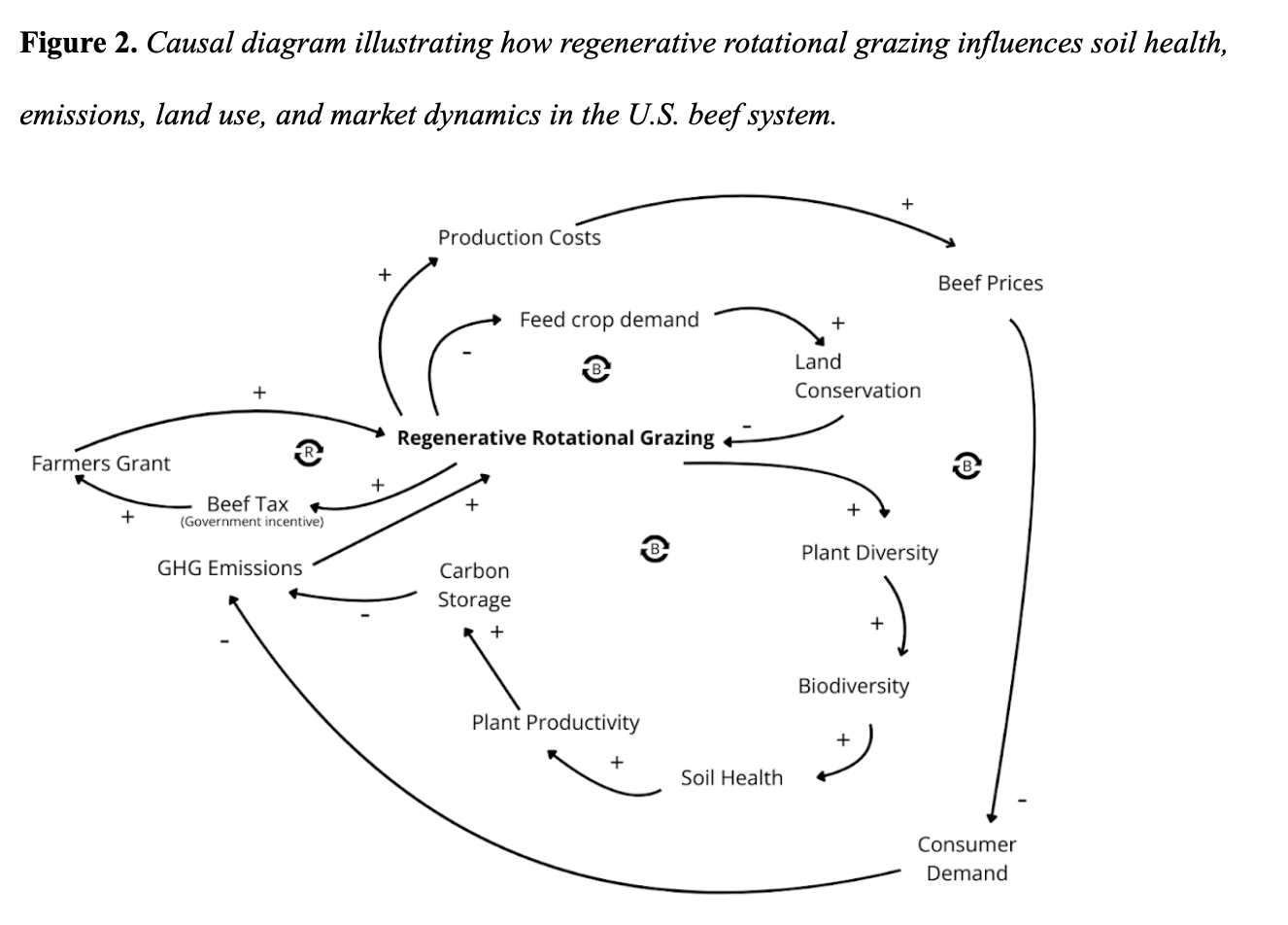
This diagram shows how rotational grazing improves plant diversity, soil health, and carbon storage, which lowers GHG emissions over time. It also includes the policy pieces we mention in Part 2, like farmer grants and a small beef tax, since those can help farmers adopt these practices and slightly shift demand. Some of the effects loop back into the system, like healthier soils leading to more productive pastures, which support the long-term sustainability of beef production.
Conclusion
This report highlights the possible changes rotational grazing can produce within beef production. Some of these changes include decreasing greenhouse gas emissions, while strengthening the ecosystems health. We are always developing more efficient methods when it comes to decreasing greenhouse gas emissions. We have made a significant difference due to the introduction of rotational grazing. Allowing us to reduce net beef GHG emissions by about 46% on average, with rotational grazing alone reducing emissions per unit of beef by roughly 37% (Cusack et al., 2021). This information was pointed out earlier in the report. But I want to emphasize the significant change possible due to rotational grazing and how effective it can be when implemented correctly. Some more advantages rotational grazing introduces are biodiversity, water retention, and soil structure. For this process to be successful, we’d need both support from government and financial assistance. This would allow for more incentive for farmers to adopt these new more sustainable methods with the support of both government and finance. Overall, rotational grazing can be a more realistic approach to lowering the greenhouse gas emissions beef produces. This can be a more sustainable practice that can decrease our carbon footprint within the U.S. beef industry.
References
Beef Manure Management Systems in Missouri | MU Extension. (2000, October). Retrieved November 20, 2025, from https://extension.missouri.edu/publications/eq377
Casagrande, D., Emanuel, L., Freitas, C., Lima, A., Nishimura, F., & Oliveira, F. (2024, June 19). Implications | Economic Research Service. ERS.USDA.gov. https://www.ers.usda.gov/publications/pub-details?pubid=37474
Cusack, D. F., Kazanski, C. E., Hedgpeth, A., Chow, K., Cordeiro, A. L., Karpman, J., & Ryals, R. (2021). Reducing climate impacts of beef production: A synthesis of life cycle assessments across management systems and global regions. Global Change Biology, 27(9), 1721–1736. https://doi.org/10.1111/gcb.15509
Drouillard J. S. (2018). Current situation and future trends for beef production in the United States of America - A review. Asian-Australasian journal of animal sciences, 31(7), 1007–1016. https://doi.org/10.5713/ajas.18.0428
Dubeux, J. C. B.; Garcia, L.; Queiroz, L. M. D.; Santos, E. R. S.; Oduor, K. T.; Bretas, I. L. Carbon footprint of beef cattle systems in the Southeast United States. Carbon Footprints 2023, 2, 8. http://dx.doi.org/10.20517/cf.2022.16
EIP-AGRI Focus Group Sustainable Beef Production System. (2021). https://www.fao.org/family-farming/detail/en/c/1629770/
Farm Credit of the Virginias. (2021, November 18). Beef Cattle Production and Lifecycle | Farm Credit of the Virginias. Www.farmcreditofvirginias.com. https://www.farmcreditofvirginias.com/blog/beef-cattle-production-and-lifecycle
Figueiredo de Oliveira, A., Costa Martins, E., Costa Alvarenga, R., Matoso Campanha, M., Rodrigues Alves, B. J., Gobbo Oliveira, L., Samia Lopes, L., & Quintao Lana, A. M. (2025). Methane and nitrous oxide emissions from excreta of different beef cattle breeds fed with different concentrate: roughage ratios and finished in feedlots under tropical conditions. Livestock Science. https://doi.org/10.1016/j.livsci.2025.105694
Jason Smith. (2023, August). Feeding and Nutritional Management of Beef Cattle—Management and Nutrition. Merck Veterinary Manual. https://www.merckvetmanual.com/management-and-nutrition/nutrition-beef-cattle/feeding-and-nutritional-management-of-beef-cattle
Livestock and Meat Domestic Data | Economic Research Service. (2025). [Dataset]. https://www.ers.usda.gov/data-products/livestock-and-meat-domestic-data
Mathews, K., & Johnson, R. (2013, April 4). Alternative Beef Production Systems: Issues and Implications | Economic Research Service. ERS.USDA.gov. https://www.ers.usda.gov/publications/pub-details?pubid=37474
Menendez, H., & Ehlert, K. (2025, March 4). The Lasting Effects of Overgrazing on Rangeland Ecosystems. SDSU Extension. Retrieved December 4, 2025, from https://extension.sdstate.edu/lasting-effects-overgrazing-rangeland-ecosystems
Montana Ranch and Cattle Company. (2024, April 29). The Battle Between Big 4 Beef Packers and Independent Ranchers. Montana Ranch and Cattle Company. https://montanaranchandcattle.com/montana-ranch-and-cattle-company-blog/the-battle-between-big-4-beef-packers-and-independent-ranchers/
Musharbash, Basel. "Kings Over the Necessaries of Life": Monopolization and the Elimination of Competition in America's Agriculture System. Farm Action, September 2024.
NOAA. (2025, August 28). Carbon cycle | National Oceanic and Atmospheric Administration. NOAA.
https://www.noaa.gov/education/resource-collections/climate/carbon-cycle
Peel, Derrell S., and John Anderson. “How We Got Here: A Brief History of Cattle and Beef Markets.” Feedlot Magazine, 3 January 2022, https://www.feedlotmagazine.com/news/industry_news/how-we-got-here-a-brief-history-of-cattle-and-beef-markets/article_1fe3c56c-6739-11ec-a5bb-2b72c548a8a4.html.
Pfost, D., Fulhage, C., & Rastorfer, D. (2000, October). Beef Manure Management Systems in Missouri | MU Extension. Missouri.edu. https://extension.missouri.edu/publications/eq377
Spradlin, S. K. (2022). The Role of Beef Imports in the United States (Master's thesis, Oklahoma State University).
Teague, R., & Kreuter, U. (2020). Managing grazing to restore soil health, ecosystem function, and ecosystem services. Frontiers in Sustainable Food Systems, 4, 534187.